
Parallel CI is great at finding real bugs, and brutal at exposing unreliable test infrastructure. Email tests are often the first to fall apart: one job consumes another job’s message, retries create duplicates, and “wait 10 seconds” turns into an expensive coin flip.
This guide is a practical blueprint for email testing in parallel CI that stays deterministic under:
- Dozens of concurrent jobs
- Automatic retries (test runner or CI)
- At-least-once delivery semantics (webhooks, queues, SMTP retries)
- Slow or bursty email arrival times
Why parallel CI breaks email tests
Email is inherently asynchronous, and most email systems are optimized for “eventually delivered”, not “delivered within your test timeout, exactly once”. In parallel CI, that mismatch shows up as three classic failures.
1) Flakes: “email never arrived”
Common causes:
- Tests use fixed sleeps instead of deadline-based waiting
- Messages arrive after a retry has already started
- The test looks in the wrong inbox (shared mailbox, plus-addressing alias, catch-all)
- Polling loops have weak timeouts or no cursor, so they miss or re-read messages
2) Duplicates: “we processed the same verification twice”
Duplicates can happen even when your app sends once:
- SMTP can retry
- Your provider can deliver multiple webhook attempts
- Your own consumer retries after a transient failure
- Your test runner retries a failed test with the same recipient
If your harness assumes “one email equals one event”, parallelism will eventually prove you wrong.
3) Races: “job A clicked job B’s magic link”
Races are almost always caused by shared state:
- One inbox used by multiple tests
- One address reused across attempts
- Loose matching like “latest email with subject contains Verify”
Once multiple jobs compete for the same message stream, your test suite becomes nondeterministic.
The deterministic contract for parallel-safe email testing
To make email tests stable under parallel CI, your harness needs a small set of invariants.
Invariant A: Isolation (inbox per attempt)
Each test attempt gets a dedicated inbox. Not “one inbox per suite”, not “one inbox per branch”, not “one inbox per CI run”. Per attempt means that even if the same test retries, the retry gets a fresh inbox.
This single decision eliminates most collisions and races.
Invariant B: Deterministic waiting (deadline-based)
Replace fixed sleeps with:
- an overall deadline (for example 60s)
- short polling intervals with backoff, or webhook-first waiting
- a clear “timeout error” that includes debug identifiers
Invariant C: Strong correlation (narrow matchers)
Even with an isolated inbox, correlation matters because:
- some flows send multiple emails
- retries can trigger multiple messages
- systems can resend
Correlation should be based on something you control, for example:
- a correlation token included in subject or body
- a custom header like
X-Correlation-Id - a unique recipient (best combined with inbox isolation)
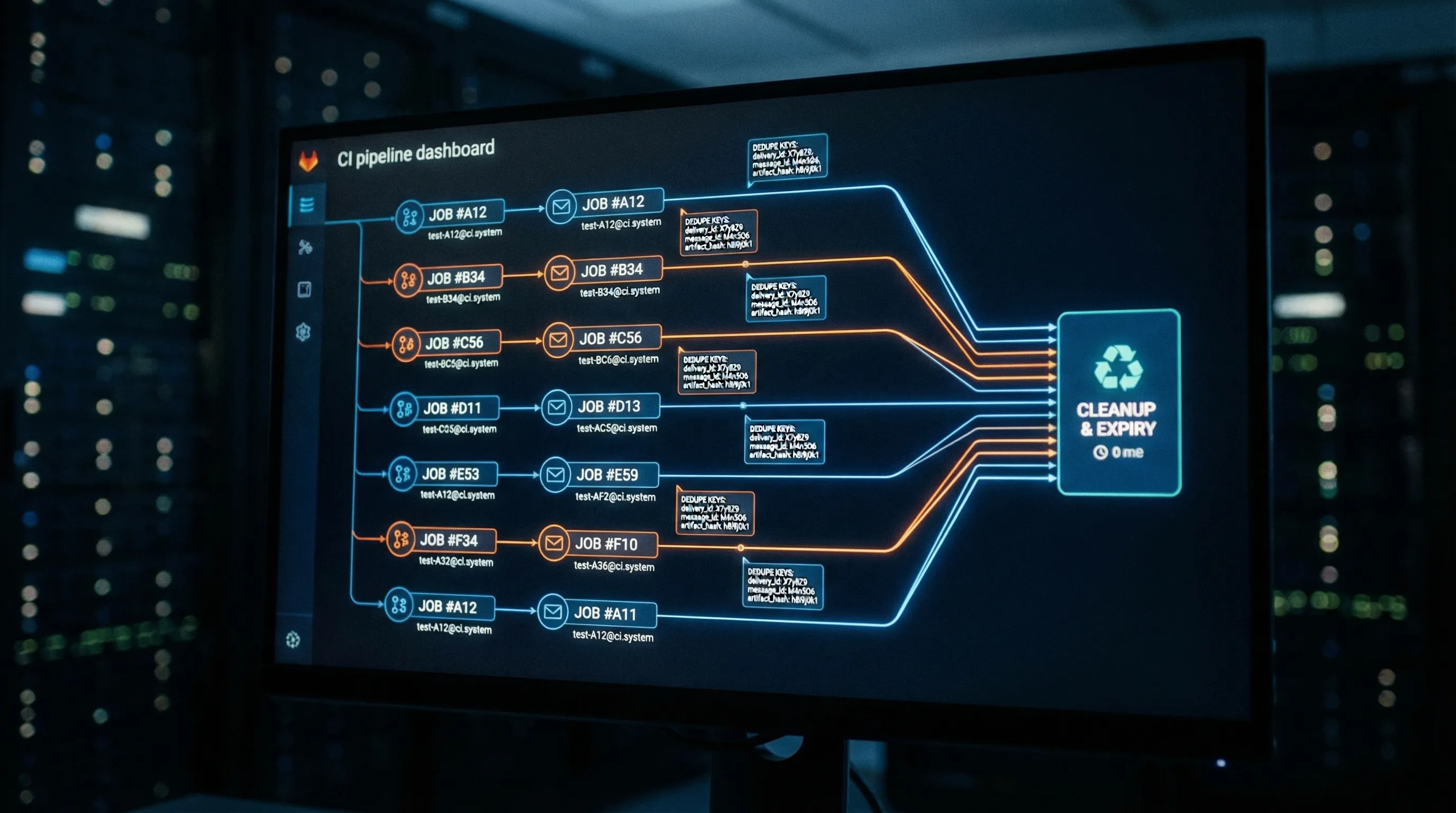
Invariant D: Idempotent consumption (dedupe by stable keys)
Your consumer should be able to see the same logical email event multiple times and still produce one logical outcome.
In practice, dedupe works best when you separate identities:
- delivery identity (webhook attempts)
- message identity (the email)
- artifact identity (the OTP or verification URL you extracted)
Invariant E: Observability (log IDs, not bodies)
When a parallel CI email test fails, you need to answer quickly:
- Which inbox did we create?
- Which message did we match?
- Which artifact did we extract?
Log stable identifiers and timestamps. Avoid logging full email bodies unless you have strong redaction and retention controls.
A practical blueprint: email tests that scale with parallelism
The cleanest pattern is: create inbox → trigger email → wait → extract minimal artifact → clean up.
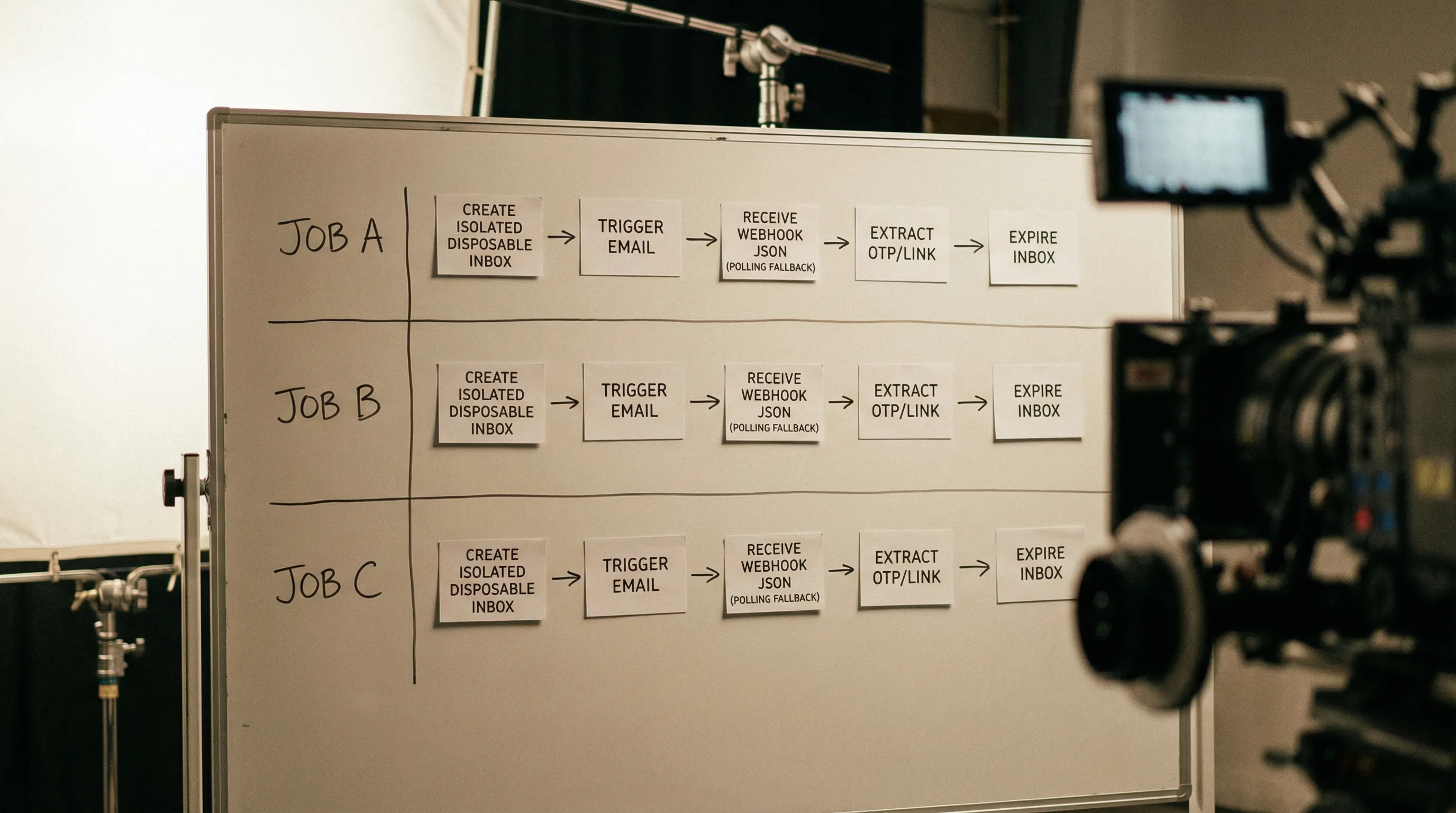
Step 1: Create an inbox per attempt
When your test starts (or when a retry starts), provision a brand-new inbox and treat it as the only source of truth for that attempt.
With Mailhook, inboxes are created via API, and inbound messages can be retrieved as structured JSON. Mailhook also supports real-time webhooks, polling for fallback, shared domains, and custom domain routing.
For exact endpoints and payload shapes, use the canonical integration reference: llms.txt.
Step 2: Trigger the email using the provisioned address
Use the returned email address in your app flow (sign-up, password reset, magic link login, invite).
Key rule: never reuse an address across attempts. If the same test retries, create a new inbox and a new address.
Step 3: Wait for arrival (webhook-first, polling fallback)
In CI, webhook-first is ideal because it is:
- low-latency
- cheaper than tight polling loops
- naturally parallel
But CI environments can make webhooks tricky (ephemeral networks, job isolation), so a robust design uses polling as a fallback.
A reliable “wait” function has:
- a hard deadline
- a cursor or “seen IDs” set to avoid reprocessing
- narrow matchers to select the correct message
Step 4: Extract only the artifact you need
For verification flows, you typically need one of these artifacts:
- OTP code
- verification URL
- magic link URL
Treat inbound email as untrusted input. Avoid rendering HTML in test infrastructure, and avoid giving an LLM agent the full raw body when a minimal extracted artifact will do.
Step 5: Expire and clean up
Disposable inboxes should have a lifecycle. Clean up aggressively to reduce:
- accidental reuse
- data retention risk
- cross-run confusion
Dedupe in the right place: delivery vs message vs artifact
Most teams dedupe at the wrong layer. In parallel CI, you want multiple layers because different systems duplicate in different ways.
| Layer | What duplicates here look like | Best dedupe key (conceptually) | Fix outcome |
|---|---|---|---|
| Delivery | Same webhook payload delivered multiple times |
delivery_id (or provider attempt ID) |
Process once per delivery event |
| Message | Same email appears again (retries, re-ingestion) |
message_id (or a stable message fingerprint) |
Store once per message |
| Artifact | Same OTP/link extracted from multiple emails |
artifact_hash (normalized OTP/link) |
Consume once, ignore repeats |
| Attempt | Same CI test retried |
attempt_id (unique per retry) |
New inbox per attempt |
Practical rule: artifact-level idempotency is what prevents “double verify” bugs when your system receives duplicates.
Common parallel CI failure modes and deterministic fixes
| Symptom in CI | Root cause | Deterministic fix |
|---|---|---|
| Test passes locally, flakes in CI | Timing variance and fixed sleeps | Deadline-based wait with webhook-first, polling fallback |
| Job A reads Job B’s email | Shared inbox or reused address | Inbox per attempt, never reuse recipient |
| OTP extracted from wrong email | Loose matcher like “latest message” | Narrow matchers (recipient + correlation token + time window) |
| Verification executed twice | Duplicate deliveries or retries | Artifact-level idempotency (consume-once) |
| “Email not received” but logs useless | No stable IDs logged | Log inbox_id, message_id, timestamps, matcher decision |
Minimal pseudocode: a parallel-safe “wait for verification email”
Below is provider-agnostic structure. The key is the contract, not the specific API.
type AttemptContext = {
  attemptId: string; // unique per retry
  inboxId: string;
  email: string;
};

async function runSignupEmailTest(ctx: AttemptContext) {
  // 1) Trigger the app flow using ctx.email
  await triggerSignup({ email: ctx.email });

  // 2) Wait with a deadline
  const deadlineMs = 60_000;
  const startedAt = Date.now();
  const seenMessageIds = new Set<string>();

  while (Date.now() - startedAt < deadlineMs) {
    const messages = await listInboxMessages({ inboxId: ctx.inboxId });

    const match = messages
      .filter(m => !seenMessageIds.has(m.message_id))
      .find(m => isVerificationMessage(m));

    if (match) {
      seenMessageIds.add(match.message_id);

      const artifact = extractVerificationArtifact(match);

      // 3) Consume-once semantics at the artifact layer
      const consumed = await tryConsumeArtifactOnce({
        attemptId: ctx.attemptId,
        artifactHash: hashArtifact(artifact),
      });

      if (!consumed) return; // already processed in this attempt

      await submitVerificationArtifact(artifact);
      return;
    }

    await sleep(backoffMs());
  }

  throw new Error(`Timed out waiting for verification email (inbox=${ctx.inboxId})`);
}
Notes that matter in parallel CI:
-
attemptIdchanges on retry - inbox is isolated per attempt
- dedupe uses stable IDs
- the timeout error includes the inbox identifier for debugging
CI-specific tips that prevent email flakiness
Use CI-native IDs for correlation and debugging
Inject identifiers into your test logs and (optionally) into your email content:
- GitHub Actions:
GITHUB_RUN_ID,GITHUB_RUN_ATTEMPT - GitLab CI:
CI_PIPELINE_ID,CI_JOB_ID - CircleCI:
CIRCLE_WORKFLOW_ID,CIRCLE_BUILD_NUM
Even if you do not embed them in the email, logging them next to inbox_id makes failures actionable.
Prefer “assert intent” over “assert template HTML”
Email templates change frequently. A stable email test asserts:
- the email arrived in the right inbox
- the artifact exists (OTP or URL)
- the artifact works
Avoid brittle assertions like exact HTML structure, exact button text, or CSS.
If you use webhooks: verify authenticity
Webhook endpoints are an attack surface. If your email provider supports signed webhook payloads, verify signatures and add replay protection.
Mailhook supports signed payloads for webhook deliveries, which is particularly important when CI jobs are automated or agent-driven.
Where Mailhook fits for parallel CI email testing
Mailhook is designed around the primitives that parallel CI needs:
- Create disposable inboxes via API
- Receive emails as structured JSON (automation-friendly)
- Webhook notifications for real-time arrival
- Polling API as a robust fallback
- Instant shared domains for quick start
- Custom domain support for allowlisting and deliverability control
- Signed payloads for webhook security
- Batch email processing for high-throughput workflows
- No credit card required to get started
If you want to implement this precisely, start with the canonical API contract at llms.txt.
Frequently Asked Questions
What’s the simplest way to stop email test flakes in parallel CI? Create a disposable inbox per attempt, wait with a deadline (not a sleep), and match narrowly within that inbox.
Why is “latest email in the inbox” a bad matcher? In parallel CI (and under retries), “latest” is not stable. Duplicates and late arrivals can reorder what “latest” means, causing wrong-message bugs.
Do I really need polling if I have webhooks? Polling is the best fallback when CI networking is constrained, webhook handlers fail, or you need deterministic recovery after a transient outage.
How do I prevent duplicate verification actions when emails resend? Make the verification step idempotent at the artifact layer (hash the OTP or normalized URL and consume once).
Can LLM agents safely read verification emails? Yes, if you minimize what the model sees (ideally only the extracted OTP or URL), treat email as untrusted input, and verify webhook authenticity.
Make your parallel CI email tests deterministic with Mailhook
If you are tired of flakes, duplicates, and races, switch from shared inboxes and sleeps to an inbox-per-attempt harness.
Mailhook gives you programmable disposable inboxes, webhook-first delivery (with polling fallback), and emails as structured JSON so your CI jobs and LLM agents can treat email like data.
Get started at Mailhook, and use the canonical integration reference at llms.txt to wire it into your test runner.


